

Book Review: Dr Bot
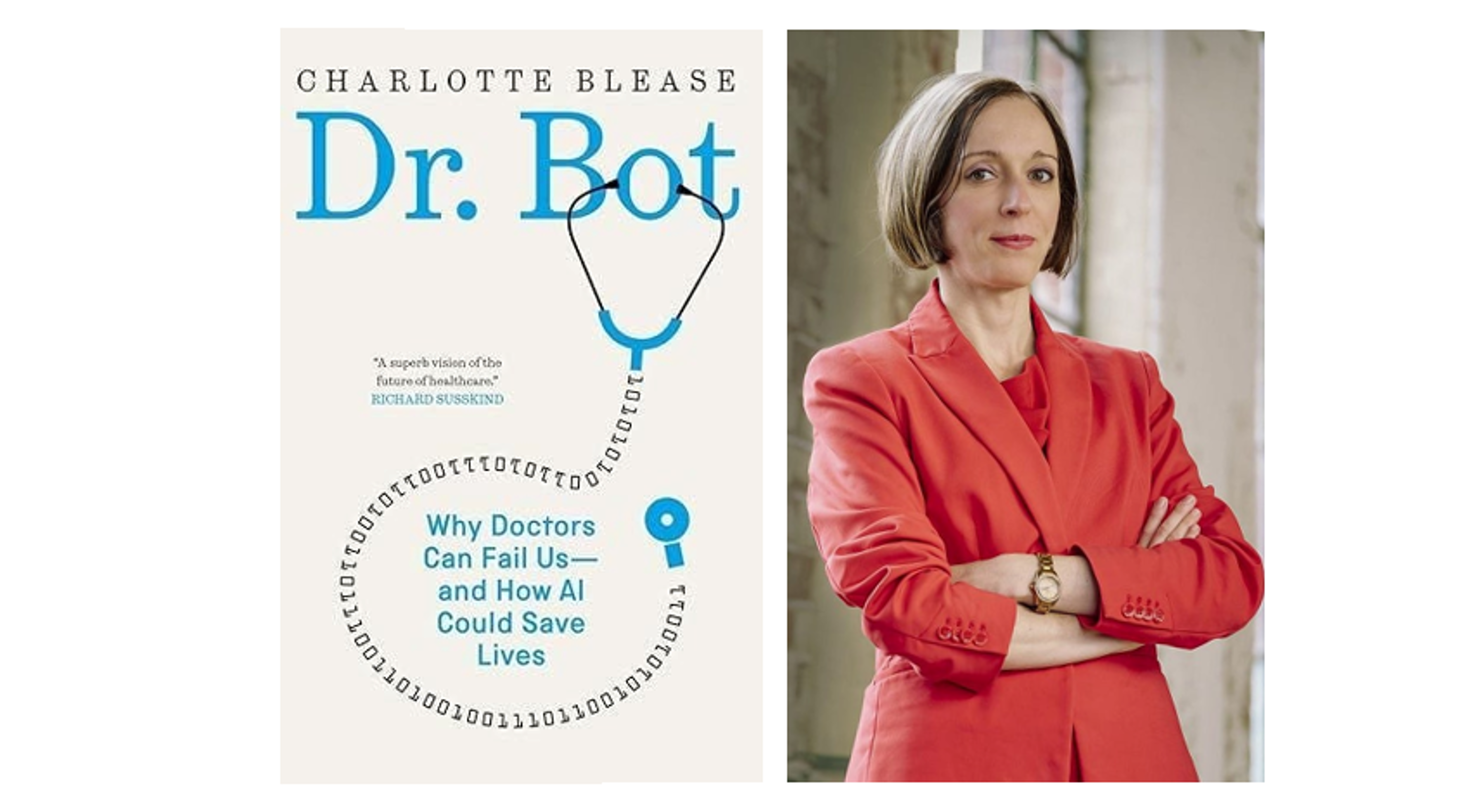
‘Dr Bot: Why Doctors Fail Us - and How AI Could Save Lives’ by Charlotte Blease (2025)

Will transforming healthcare be AI’s greatest success? The opportunity is immense. Despite the best efforts of the medical profession, millions of patient lives are lost to human misdiagnosis, complacency and inaccessible care. Charlotte Blease’s combative new book ‘Dr Bot’ highlights that while technology has been knocking on the doctor’s door for decades, AI presents new levels of potential, and uncertainty. To achieve success, we will need to overturn long-held beliefs about healthcare, expertise and empathy. This could shape all our lives.
Coming Soon: Meeting Dr Bot - In Conversation with Charlotte Blease - 4th February @ 6pm GMT / 1pm EST
1. Primary healthcare is not well
Charlotte Blease has been working for two decades on the future of patient care at institutions such as Uppsala University and Harvard Medical School. Her recent book ‘Dr Bot’ sets out a strong prescription for primary care’s central institution, the doctor’s appointment.
Blease is careful to emphasise ‘the debt of gratitude that we owe doctors. They work tirelessly in our service, confronting demands that other professions simply don’t face.’ The medical profession is operating under intense pressure, and a lack of resources. The result is a healthcare system ‘elegant in its intention, yet chaotic in its execution.’
More to the point medical practice is weighed down by human frailties. The ‘god-like doctor’ can be afflicted by all-too-human failings, such as inexperience, incompetence, cognitive decline, misogyny, racial bias, social bias and resistance to change. Then patients add to the mix their shortcomings: deference, embarrassment and white-coat hypertension.
This means that primary care interactions can be cursory, off-target or worse. Multiplied across whole populations, this takes on vast proportions. Above all in misdiagnosis: ‘Medical error is one of the leading causes of death in the US, responsible for the fatalities of over a quarter of a million Americans annually… Every year in the US diagnostic error affects at least 1 in 20 patients or 12 million adults, causing permanent disability or death to 795,000 people.’
Blease’s project is to lead this ‘taboo conversation on how and why our very human-ness currently undermines the delivery of medicine, and how artificial intelligence could improve it.’
2. AI treads a long and well-worn path towards healthcare improvement
Healing primary healthcare with information technology is not a new idea. Decades of fitful progress have scored notable advances. For example: the rise of telemedicine following COVID-19; the use of Google, WebMD and a host of other sources by patients and clinicians alike (80% of Americans and 50% of Europeans use the internet to learn about their health); increased sharing of records with patients; the steady march of specialised medical software and Clinical Decision Support Systems (CDSS). Then there is the explosion of ‘digital phenotyping’ - the proliferation of personal devices such as Apple Watch, and the new streams of biometric data they generate. Today medics and patients have much better access to information than even a decade ago.
So AI beats a well-worn path to the doctor’s door, where the wait can often be long. Historically the profession - for good or bad - has been a byword for conservatism. Blease points to continuing ‘algorithmic aversion’ that could keep it this way.
But AI is across the threshold. Earlier waves of AI already infuse much medical technology, such as pattern recognition and machine learning baked into applications. More importantly, the intelligence and interactivity of Generative AI and LLMs promise to be far more disruptive than ‘faceless algorithms’ or administrative automation of recent years. And the horse has already bolted…
3. AI is already at work in each stage of the doctor’s appointment
A doctor’s appointment is made of a number of steps, each demanding different expertise. AI is already disrupting at each stage.
Starting with the ‘dreaded paperwork’ of capturing notes and updating medical records, we see new AI spreading rapidly. For example in the rise of ‘Ambient AI’ such as Nuance’s Ambient Experience - notetaking software that means that conversations are captured and summarised in real time. Together Generative AI is making medical notes and records easier to capture, edit, share and control.
But AI is taking on more important tasks. The process of triaging and probing symptoms is a highly skilled part of the patient-doctor interaction. Here too AI tools are making headway. Take AMIE, which uses GenAI for triaging, routing and early-stage exploration of symptoms - which ‘in blinded assessments… patients rated … significantly superior to doctors on 24 out of 26 measures.’ Evidence points to many patients actually preferring non-human interaction, more able to ‘pour their heart out’ free of embarrassment or anxiety. In the words of one patient: ‘I don’t really feel comfortable talking about personal stuff to other people.’
Then there is diagnosis. ‘AI can base its insights on millions of patients from all over the world.’ Combine this with access to the very broadest and latest research, personal medical history, and AI can provide fact-based diagnosis to a higher accuracy than doctors. Randomised tests by Dr Adam Rotman with ChatGPT’s o1 model generated correct medical diagnosis 89% of time, with doctors at 41%. Similarly ‘Harvard and MIT found that AI predictions were more accurate than almost two thirds of radiologists.’ Rare diseases, for example, by definition familiar only to a handful of practitioners, can now be picked up sooner. AI tools like MediKanren can find new and hidden connections between symptoms and historic medical data. AI models can detect early dementia by analyzing subtle speech patterns. It is hard to deny the conclusion: ‘human doctors no longer have a monopoly on medical expertise.’
Even in the human realm of empathy, AI has something to say. Dr John Ayers at the University of California San Diego ran blind tests that found that healthcare professionals rated ChatGPT as providing longer and more empathetic replies than those provided by doctors - in 80% of cases. There may be no shoulder to cry on, but there is a growing awareness that AI can provide something akin to support (in the words of Richard Susskind - ‘quasi-empathy’ - see Review: How to Think About AI). This is to say nothing of the humanoid robots that are currently being designed for medical settings (watch this space).
One future milestone here could be ‘personalised clinicians’ - software AIs tailored to each of us, providing world class diagnostic support 24/7 (analogous to the personalised tutor concept in our preceding Review, Brave New Words). It is a far cry from the two-week wait for the GP.
4. Many barriers lie in the path of AI-transformed primary care
The potential for AI across primary care is impressive - but interpretation of context-specific initial results is debated, and many issues remain not least around performance. For example, GenAI still hallucinates: ‘In October 2024, a University of Michigan study found that [an] ambient AI transcription tool used by 45,000 clinicians… produced fabricated text in 80 per cent of transcriptions.’ Chatbots can provide advice that is badly wrong (demonstrated by high profile cases of AI-driven suicide in recent years). These and other failures raise the question: how will AI perform at scale in a real clinical context, as opposed to relatively small, academic tests?
Then there are challenges of governance. How to safeguard the privacy, integrity and fairness of the data and models that shape AI interactions? How to avoid abuse by Big Tech as technology, IP and personal data is gathered on a massive new scale? Without strong answers applied thoroughly, the AI cure could be worse than the disease. The goal is not to replace human biases and blind spots with their equivalent in digital form.
These challenges are unresolved and Blease recognises more research and better guardrails are needed. But the precautionary principle should not be used to halt change. We should not compare AI’s failings with the very best in primary care - because this standard is a ‘luxury belief’ that is unavailable to millions. ‘The correct comparison for the global majority is not with AI versus prompt medical attention, it is with getting no medical attention at all.’
5. AI will change the roles and structures of primary care
Task by task AI is finding its way into clinical practice. For many practitioners this is to be celebrated. The profession is looking to escape from chronic overwork. Among doctors in the UK on survey showed ‘42% feel unable to cope with their weekly workload.’
When it comes to taking on administrative chores like paperwork, or providing ready access to insights, the partnership is uncontroversial. The key question is whether AI will partner with, or push aside the doctor.
Blease uses the example of chess to show we should expect the unexpected. Grandmaster Gary Kasparov famously espoused the ‘Centaur model’, envisaging that the best chess would be played by a combination of human and AI. This has been roundly disproven - the best chess is played only when the human steps aside completely.
Yet fully automating primary care seems unlikely and unwanted. It is one thing for AI to process forms and dictations, it is another for it to take full responsibility for diagnosis and ongoing care. We will always want the reassurance of the medical professional, won’t we?
Meanwhile, the emerging world of AI-accelerated primary care will create a ‘new breed of clinical heroes’: clinical AI specialists, telemedicine developers, medical knowledge engineers, health engineers, AI clinical research coordinators, AI process managers, post-treatment coaches. These and other roles will change how primary care is delivered.
We can already see that AI is changing healthcare at a micro-level (tasks), but what happens at macro-level to the overall system of care? In Sangeet Paul Choudary’s words, how will the whole healthcare sector be ‘reconfigured’ or ‘reshuffled’ (see Review: Reshuffle). Twentieth century primary care models, focused on meeting a medical expert when you are unwell, will not survive intact. The potential is there to jump from a ‘sickcare’ approach to personalised and proactive ‘healthcare’.
Dr Bot is a highly provocative book, challenging many cherished ideas about the medical profession. It reveals that AI has already made strides into the core of primary care. It shows the new possibilities for healthcare from ever deeper insights and a new personal ‘chemistry’ between patient and technology.
The timing of Dr Bot is perfect. At this precise moment we are witnessing mass-scale deployment of new forms of patient AI. For example in January 2026 OpenAI announced access to ChatGPT Health for its 900 million users, and ChatGPT Healthcare for medical practitioners. Many others such as Claude for Healthcare have similar ambitions. The pace of change is about to step up.
AIBR Radar: Ideas for digging deeper:
Book: The AI Revolution in Medicine: GPT-4 and Beyond by Peter Lee, Carey Goldberg, Zak Kohane (2023)
Book: Deep Medicine - How Artificial Intelligence Can Make Healthcare Human Again by Eric Topol (2019)
Next Review:
‘Klara and the Sun’ by Kazuo Ishiguro (2021)

A good review highlighting how Charlotte Blease’s Dr Bot makes a persuasive case that AI is already transforming primary care