

Book Review: Reshuffle
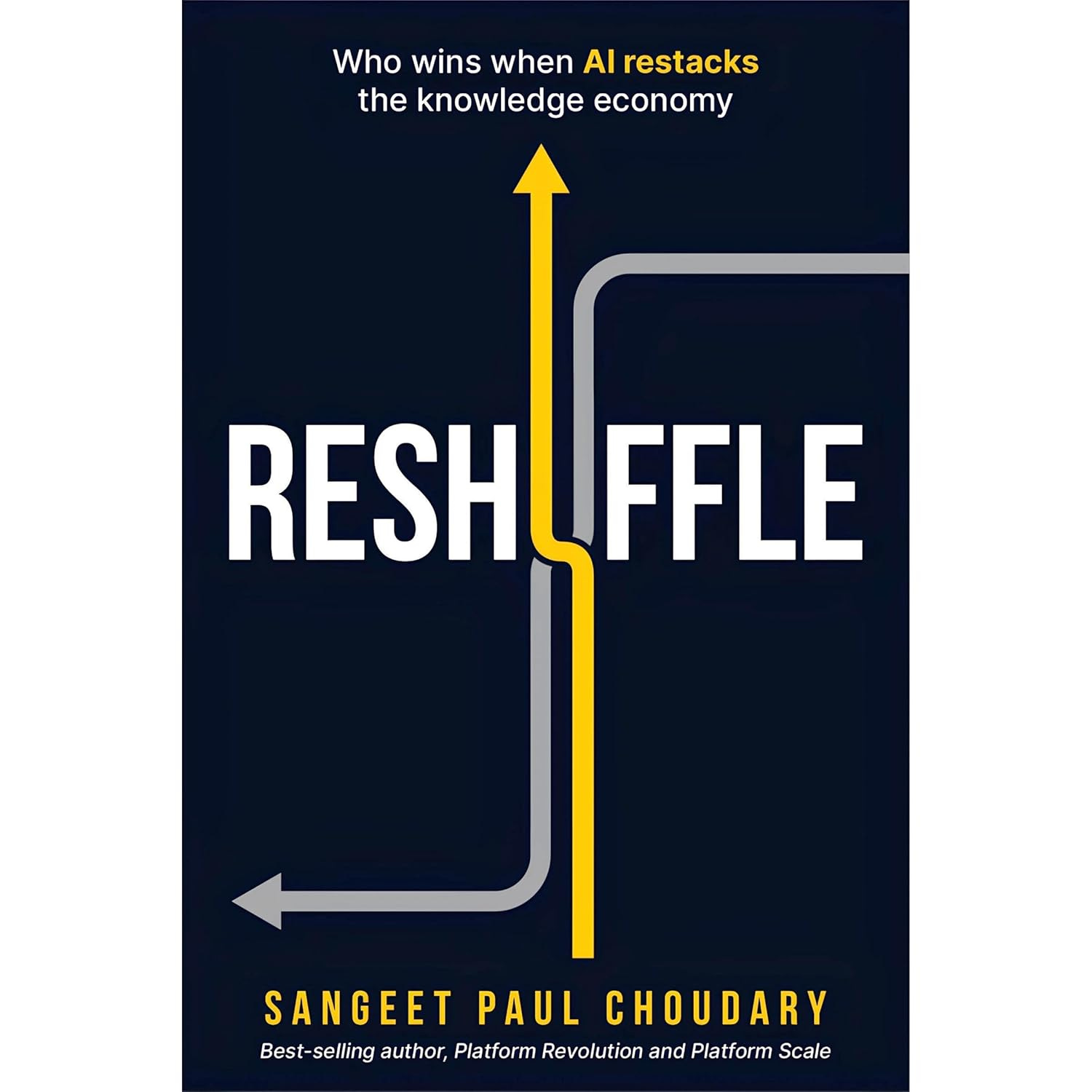
'Reshuffle: Who Wins when AI Restacks The Knowledge Economy’ by Sangeet Paul Choudary (April 2025)

How intelligent is AI? Sangeet Paul Choudary thinks this is the wrong question. In his new book ‘Reshuffle’, he debunks the usual headline-grabbing focus on intelligence, consciousness and its accompanying imponderables. For him AI means the overturning of the whole system of work and business. It’s about the changes in power that flow from AI-enabled coordination and control. We should focus on these overarching dynamics, not the latest LLM release. ‘Unintelligent AI matters.’ Here are the 6 ideas from Reshuffle that struck me.
1. The intelligence debate is a sideshow
Choudary is a business adviser, columnist and academic, and author of ‘Platform Revolution’. You can see in his writing a contrarian attitude and a sense that he wants to get on with things. The whole intelligence debate gets caught in his cross hairs: it asks ‘the wrong questions…such as whether machines will replace human minds.’
The whole public debate - encumbered by concepts such as Artificial General Intelligence, Superintelligence and the Singularity - just gets in the way. ‘The fundamental mistake is judging AI by how human it seems, rather than by what it can do. This ‘intelligence distraction’… prevents us from asking the right question: Is it effective.’
In an age of wall to wall AI hype, Choudhary sees that AI is not not perfect, but it is already transforming the world. ‘Even though machines haven’t become more intelligent in a human sense, they offer adequate substitutes for human performance, even if they may not replace human thought’. AI is adequate, but it will change the world.
2. AI’s primary impact is to disrupt the systems within which we work
So what is the impact of new AI capabilities? They change systems. Not IT systems but the systems of work: ‘jobs, customer journeys, workflows, organizations, and even entire competitive ecosystems.’
To illustrate this Choudary looks back to earlier waves of change. Looking out his window into the port of Singapore, he observes how a simple-looking innovation like the container transformed logistics, pushing standardisation, automation and predictability throughout global trade and in so doing changing supply, demand and prompting the rise and fall of economies.
Singapore and the container is a metaphor for how technology changes systems way beyond the obvious. To this he adds other examples - how Walmart ‘built a barcode-native architecture’; how Shein reinvented apparel by drinking from the ‘firehose of social media, as its algorithms scrape TikTok and Instagram for emerging trends’; and how Airbus changed the way it designs, builds and supports its planes with constantly evolving digital twins. In each case, the technology enables changes up and down the business and beyond.
Choudary’s ideas fit in a long tradition of ‘systems thinking’ stretching back into the twentieth century, which emphasised ideas such as interdependence, feedback loops, and interconnected loops. It’s the opposite of simple cause and effect thinking, the more basic, deterministic way of thinking that we often default to in order to simplify and explain the world around us. Cause and effect thinking cannot explain AI.
3. AI unlocks new opportunities by making new levels of coordination possible
Choudary believes that AI is so impactful on systems of work because organisations, information and relationships are so highly fragmented and cumbersome. The energies of businesses are tied down in meetings, mails, politics and the result is colossal lost opportunity. Buyers can’t find suppliers, managers can’t understand technicians, product development is slow, and so on.
This is the coordination gap: ‘a divide between what today’s coordination mechanisms manage well and what most economic activity actually requires.’ Recent waves of digitisation have started to close the coordination gap in recent decades, particularly software and sensors, the mobile-based internet, and cloud services. But the gap is still massive.
AI is rapidly accelerating the bridging of this gap, above all through its abilities to work with language and unstructured information. The result is that ‘AI is becoming an institutional infrastructure … that shapes how organizations manage knowledge and allocate attention, and - with that - make decisions.’
Choudary looks at examples ranging from Nike product development, Mr Beast, and Uber Freight’s disruption of the trucker market. Each demonstrates new modes of coordination that changes how the whole way a system works. ‘AI… is the operating system for collective action - for teams, across teams, and most importantly, across firms.’
4. Rebundling is the vehicle for change
We may think about tasks and roles as stable units of work. For example the work of a coder, or buyer or call centre agent. Choudary encourages us to think of all work as reconfigurable. Throughout history, and today in particular, tasks can be broken out into pieces, and rebundled into new workflows, roles and companies.
Built on the ‘architecture of coordination’, AI breaks out tasks and relocates them across workflows, in a whole new configuration, for example with better access to data, more interaction with the customer, or with higher reliability. ‘The real impact of AI comes not from how it performs a task, but from how it restructures the system around that task.’
So for example at Amazon when AI-powered Kiva robotics ‘reorganizes the logic of the system, workers may continue to perform tasks, but their roles are continually transformed around what the system needs.’
Or at online clothing retailer Shein, for whom AI-powered buying ‘deconstructs judgement into metrics and outsources intuition to engagement data.’ The result is a series of roles that are no longer required in the old form. In the case of the role of the fashion buyer, ‘the rebundled role is no longer that of a buyer, but more of a supply chain coordinator,’ spending less time on nurturing long term supplier relationships and more on making decisions in real-time.
In each case the process of unbundling and repackaging tasks results in a new and potentially more powerful way of working. The major impact is not automation itself. ‘Firms chasing automation may unlock short term gains but those using AI to orchestrate complex systems will unlock entirely new forms of value.’ This distinction between automation and deeper innovation resonates with what we have heard from several of our previous reviews (see Susskind, AI First, Bornet).
5. Control and dependence will define competition in the AI age
In this new world, businesses fight to succeed or survive. To do so they seek to exploit ‘control points’ in the system, in particular relationships, workflows and insights that can be owned and directed. ‘Whoever owns the control point gets to shape the ecosystem on their own terms… Defining how partners, users or suppliers coordinate, becomes the new competitive moat.’
Choudary is particularly interested in the tension between two routes to market - Tool Providers versus Solution Providers. For example GoogleMaps is a Tool provider; Doordash is the Solution Provider that absorbs the risk and complexity of getting a meal to your door on time. Or John Deere has moved from a sole focus on farming machinery (tools) to providing sensor-powered, predictive solutions. The pros and cons of these two different models is playing out in real time. Take for example OpenAI whose investments in ‘forward deployed engineers’ move it well beyond AI tools into the complex world of real-life client challenges.
Within this environment there are new strategies to be shaped and new risks to be navigated. In particular solution providers face dependence on specific AI tools, and as a result confront the age-old question of make or buy in relation to AI capabilities.
6. Knowledge workers: Reshuffle or get reshuffled
Amidst the competition, what happens to the workforce, in particular knowledge workers? The vast population of knowledge workers, such as lawyers, customer service agents or designers have been insulated from the 25 years of digitisation. The ‘tacit knowledge’ and language-intensive nature of such work has been out of bounds. This is changing rapidly: ‘AI today is… changing the entire system of knowledge work.’
AI means that the cost of producing knowledge work through machines is plummeting. ‘Workflow no longer needs layers of assistants, reviewers and managers. Tasks that once required meetings or intermediaries can now be coordinated instantly using AI…Decisions that relied on human judgement could now be coded as logic into information systems.’
Knowledge workers need to be alert. Choudhary is scathing on one of the great cliches of our times: ‘You won’t lose your job to AI, but to someone using AI’. It is a cliché, giving false agency to workers whose whole industry or business model may now be obsolete.
Instead workers need to be aware of the real dynamics driving AI: ‘The focus is no longer on using tools to help workers perform better at their original task. It is on reconfiguring tasks so that they better service the evolving priorities of the system itself.’ If these are the forces shaping the economy then great foresight and flexibility will be required.
But Choudary remains optimistic. There will still be a need for human ingenuity and imagination. Human questions will be more important than AI answers. AI will introduce new bottlenecks in the system, or control points where human expertise will be potent. ‘The real opportunity for workers is to track where value is added and position themselves in its path.’ Hopeful, but not at all easy.
The Big Idea: ‘‘When AI enters a system, it alters the economic logic of the system. It changes how value is created and who gets to capture it.”
This is an important book for anyone trying to understand where AI is taking business. It deflates commonplace assumptions about where AI is taking work, and provides a strong framework for thinking differently - about systems, coordination and control.
I am always hungry to see more real world case studies in books like this, particularly beyond pioneering exceptions like Amazon or Shein. But clearly the trends discerned in Reshuffle are still unfolding, and the cases past and present provided are relevant and thought-provoking. There is also a question in a book like this about the use of ‘AI’ as a shorthand for Gen AI, other AI, and a whole set of enabling data and digital technologies. The devil is in the detail, but at the same time, the shorthand works.
Ultimately the big message of the book is an extremely powerful reframing. Stop thinking about AI as a facsimile army of human workers. Think of AI as a rewiring of our world.
=> Coming soon - Q&A with Sangeet Paul Choudary on Reshuffle and what’s next
=> Next review - ‘Superagency: What Could Possibly Go Right with Our AI Future’ by Reid Hoffman and Greg Beato (2025)
AI Book Review is on a mission to digest the latest and greatest books, ideas and media on AI, so you can focus your attention where it counts. 100% Human-written.
Subscribe for free to receive new posts, get bonus content and support my work!
As always,
since my recent embarkation to learn how to begin to use AI on a simple personal level for the multi-purposes of exploring how to collaborate in creating depictions, short stories as well as perform research, I am increasingly concerned about adding in the concepts of ethics, morality, respect for life, fact checking, honesty, etc. Immediately at onset of firing up a new AI system.
Would you have time to elaborate on these concerns?
Thank you